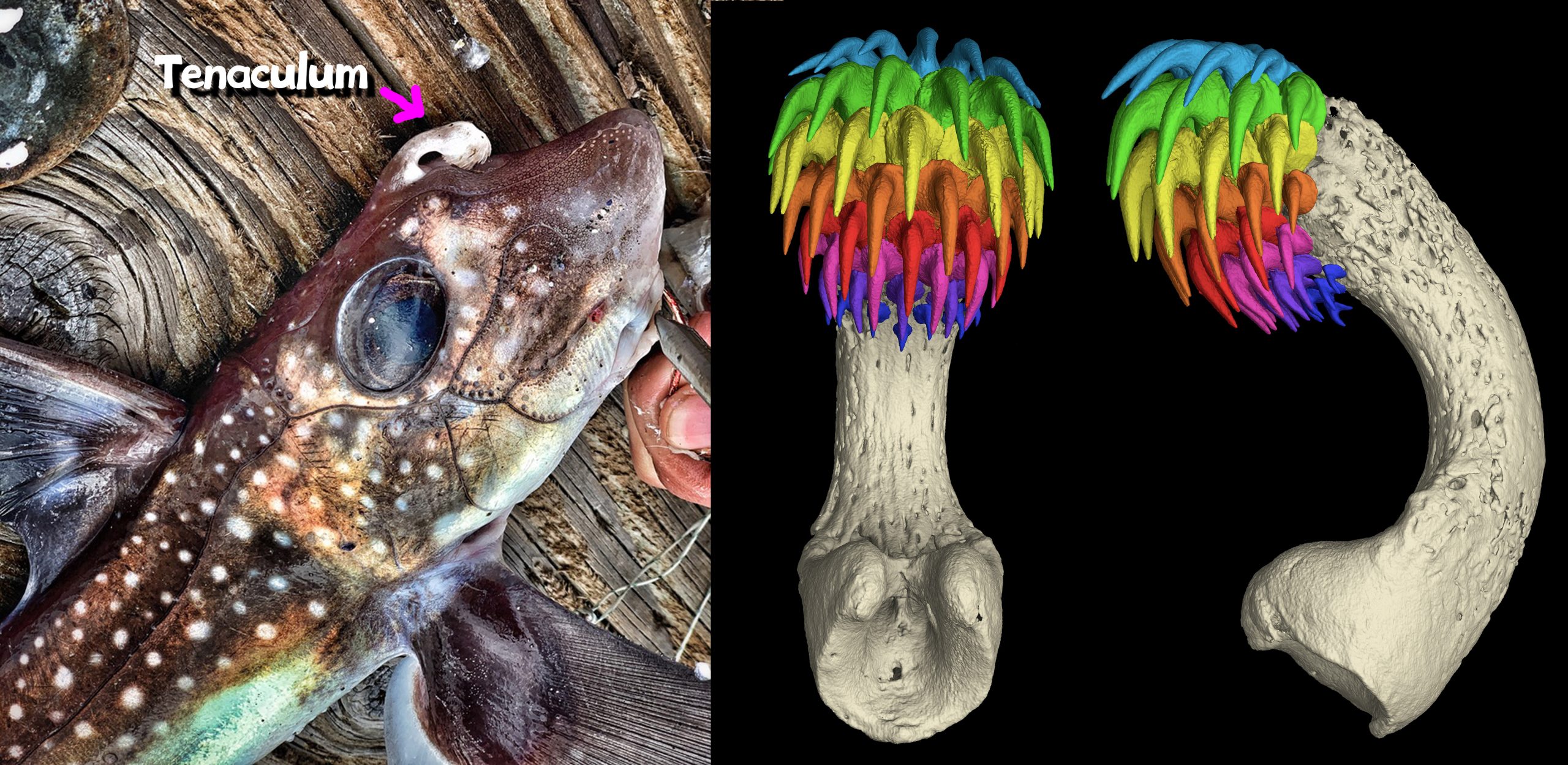
A new study published in the Proceedings of the National Academy of Sciences from the Gareth Fraser Lab has shed light on the evolution and development of a strange appendage that sits on the forehead of ghost sharks. The articulated club-shaped rod of cartilage, called a tenaculum, present only in male ghost sharks or chimaeras, is adorned with rows of teeth and used to “bite” down on female pectoral fins during copulation. In collaboration with the University of Chicago and the University of Washington, Friday Harbor Laboratories, the team studied Spotted Ratfish from Puget Sound, WA and compared the development of the teeth on the tenaculum to fossils from the carboniferous period (~315 million years ago) and found that the teeth on the tenaculum were more closely related to oral teeth, like those found in the mouths of sharks, than to the tooth-like denticles found in the skin of sharks and their relatives.
Links:
- https://www.pnas.org/doi/10.1073/pnas.2508054122
- https://news.ufl.edu/2025/09/ghost-shark-teeth/
- https://www.nytimes.com/2025/09/06/science/ratfish-chimaera-ghost-shark-teeth-sex.html